
The De Pree Art Center at Hope College will open a new exhibition titled, “Notes on Cloud Formations” featuring interdisciplinary artist Candace Hicks. Exhibition dates are Oct. 9-Nov. 5, 2026.
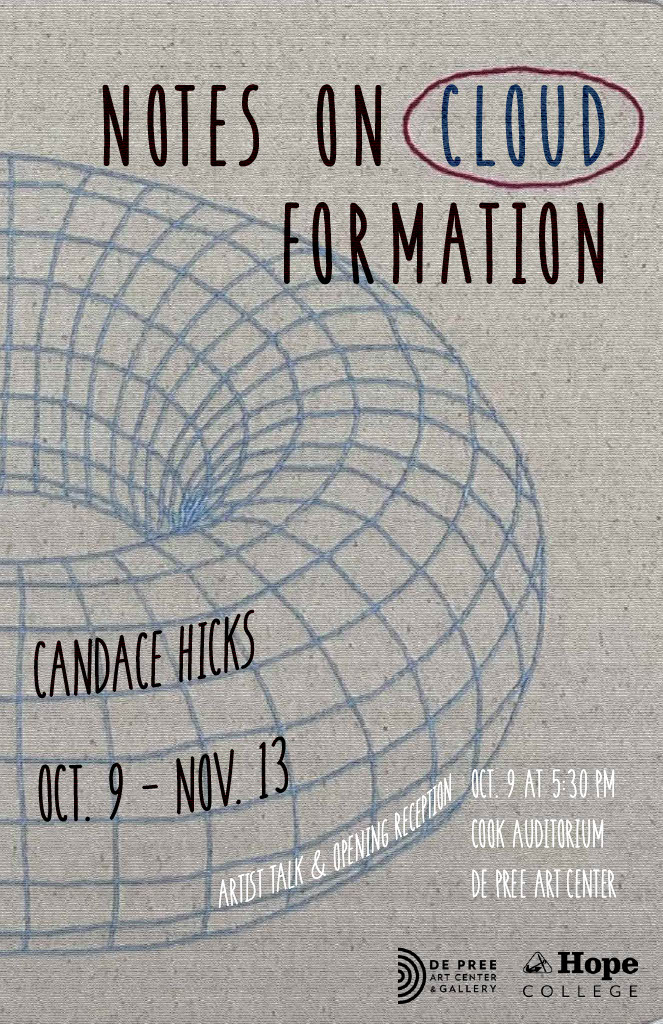 In launching the new exhibit, Hope is hosting an artist talk on Oct. 9 at 5:30 p.m.
in the Cook Auditorium at the De Pree Art Center, followed by an opening reception
at 6:30 in the De Pree Gallery. Both events are free and open to the public.
In launching the new exhibit, Hope is hosting an artist talk on Oct. 9 at 5:30 p.m.
in the Cook Auditorium at the De Pree Art Center, followed by an opening reception
at 6:30 in the De Pree Gallery. Both events are free and open to the public.
Candace Hicks collects coincidences from the books she reads and gathers them in her artists’ books and installations. Her compendiums of coincidence are records that show the world through a particular, specific, and sometimes obsessive, point of view. Books from her Common Threads series are in more than 90 collections around the world, including: the Metropolitan Museum of Art, Museum of Fine Art Houston, Boston Athenaeum, Deutsche Nationalbibliothek, Grolier Club, Harvard, Hungarian Multicultural Center, MIT, MoMA, Museum of Applied Arts, Vienna, UCLA Biomedical Library, Stanford, and Yale. She is an associate professor at Stephen F. Austin State University where she teaches foundations. In 2025, she completed a Fulbright U.S. Scholar project in France and in 2027 she will represent the state of Texas at the National Women’s Museum in an exhibition devoted to expanded artist’s books.
 Artist Statement
Hicks focuses on the hand-made and domestic as metaphors for the feminine perspective.
Literature informs every project, and combining textile and text, allows her to explore
the ways we construct meaning from mundane coincidences. Inspired by genre fiction,
she critically assesses the morality of our obsession with murder mysteries and investigates
the ways that science fiction has a hold on our collective imagination. Privileging
craft traditions, Hicks employs embroidery to illustrate interconnected stories.
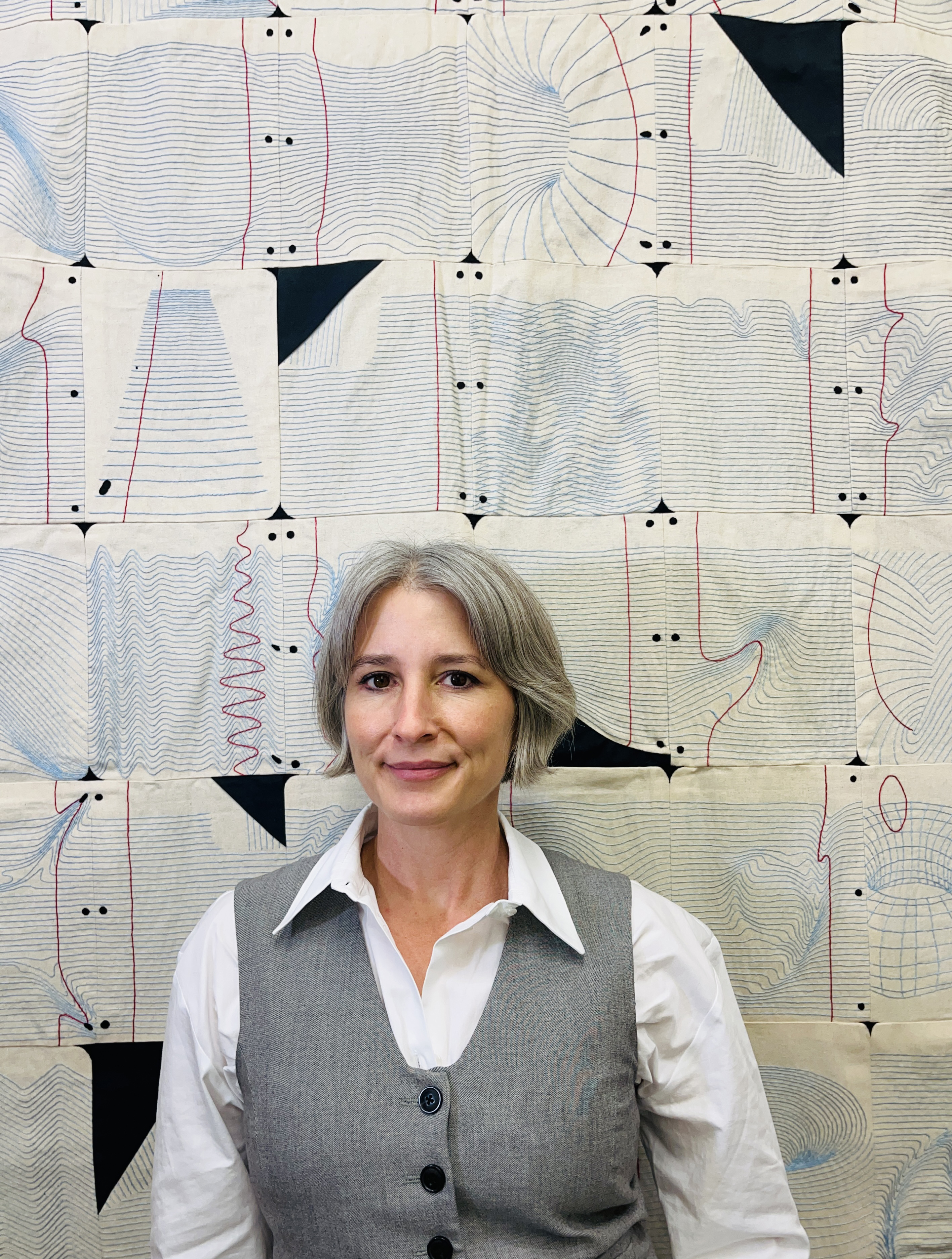
Notes for String Theory are hand-embroideries that confront the existential possibilities of the blank page. The size, format, and color palette of the notebook paper is familiar and warped at the same time. From across the room, they appear as flat, linear designs, but upon closer inspection reveal themselves to be delicately textured. Hicks has taken literature as her subject for many years and writing has been central to her artistic practice. She discovered the potential of the blank page as generative when she was experiencing writer’s block. When the stories and commentary that had previously poured out of her ceased, Hicks began drawing versions of a blank sheet of paper in blue thread onto canvas. Where Hicks had previously embroidered the text and illustrations from her artist’s books, she created a void. Not the first or last to confront the dread of the blank page or to bend writer’s block into subject matter, she has named her humble drawings as a theoretical framework uniting all matter and forces at play in the universe.