
After steady student growth in the Hope College neuroscience program, the college announced it has advanced as an official department, effective this academic year. To honor this achievement the new Department of Neuroscience will host a celebration on Wed., Nov. 11 at the Kruizenga Art Museum on campus from 4-6 p.m.
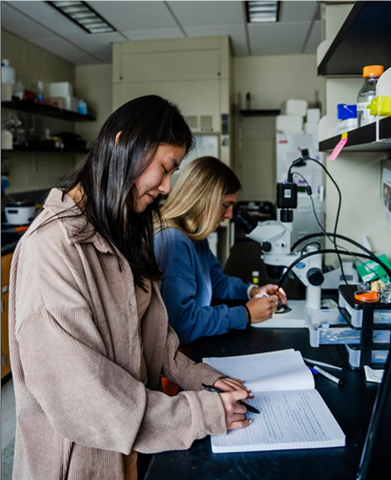 Dr. Andrew Gall — associate professor of psychology and neuroscience — is serving as the department
chair, having served as program chair for the last several years. Dr. Leah Chase — the Edward A. & Elizabeth Hofma Professor of Biology & Chemistry — led the application
process with Gall. They worked with the Provost’s Office, the college’s Academic Affairs
Board, Curriculum Committee and the Hope Board of Trustees, which approved the department
status. The department will remain housed within the Natural and Applied Sciences
Division.
Chase joined Hope’s faculty in 2000 and was involved in establishing neuroscience as a minor in 2004 and as a major in 2018. By 2020 there were about 20+ total students declaring it as their major or minor. Today, 90 students list neuroscience as their major or minor, said Chase. “It was clear to many of us that this subject was growing beyond a program and would continue to thrive if it operated within a departmental structure,” she said. “Gaining board approval was very affirming. Thinking back to before this discipline was represented at Hope to where it is now, and seeing so many students and faculty involved in this program, is so rewarding,” adding that Hope is one of just a handful of liberal arts colleges with a neuroscience department.
The last department to form at Hope College was engineering, nearly 20 years ago.
“It has been wonderful to watch the efforts of faculty and staff pour into students who are interested in the interdisciplinary field of neuroscience,” said Provost Gerald Griffin. “With this effort, more and more students have been attracted to the minor and the major so much that it necessitates Hope's newest department.”
Neuroscience is the scientific study of the nervous system, considered by many as the most complex organ system in the body. The Hope neuroscience curriculum includes foundational courses in biology, chemistry, neurobiology, neurochemistry, engineering and mathematics. Students also have elective opportunities in complementary courses such as nursing, philosophy, psychology and computer science to round out their major requirements (57 credit hours) or minor (21 credit hours). Among the active neuroscience department faculty are: Dr. Chase, Dr. Gall, Aaron Welsch, Dr. Erika Calvo-Ochoa, Dr. Daniel Dorman and Provost Griffin.
Adding to the rich curriculum at Hope are the extensive student-faculty research opportunities that all neuroscience major and minor students participate in, receiving personalized attention in small group settings.
History of Neuroscience at Hope
The neuroscience program started at Hope College in 2004 as a minor degree program,
with grant support from the Howard Hughes Medical Institute. There were 10 students
in that first cohort. The original interdisciplinary neuroscience program was the
initiative of the biology, chemistry and psychology departments, with one faculty
member from each contributing to the program.
After consistent growth and student interest, Hope added a neuroscience major degree program in 2018. The neuroscience major consists of 57 total credit hours while the minor program consists of 21 credit hours. Between 2019 and 2025 the number of declared neuroscience majors increased nearly five-fold and the number of declared minors tripled. Neuroscience majors have matriculated into doctoral programs in the same field and in clinical psychology, in pre-professional programs such as medical, optometry or dental school; and graduate programs in nursing, physical therapy and speech and language therapy.