
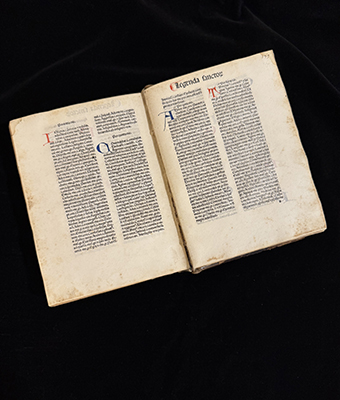
In honor of the 1,700th anniversary of the Nicene Creed, Hope College and Western Theological Seminary (WTS) will co-host a panel discussion titled “Faith in Manuscript: Celebrating 1700 Years of the Nicene Creed” on Thursday, Jan. 29 at 4 p.m. at Hope’s Van Wylen Library. This interactive event will feature a faculty panel followed by a period of hands-on discovery, where the public can explore a curated treasure trove of rare books connected to the history and dissemination of the Creed.
The “Faith in Manuscript” event reflects how the shared beliefs of the early church were physically passed down through handwritten scrolls, early printed books, and, ultimately, into the life of the church today.
The panel will include Todd Billings, Wayne Brouwer, Sarah Lundy, Steve Michaels and Jeff Tyler— representatives from Hope College and WTS. Together, they will discuss the context of the Council of Nicaea, the key elements of the Creed, and how the Creed was originally recorded and disseminated. The discussion will also highlight how some rare books from the Van Wylen and Cook Library collections illustrate elements of the Creed’s journey throughout history.
Hands-On Discovery:
Following the panel discussion, attendees will have the opportunity to interact with a selection of rare volumes from the 15th — 18th centuries, including:
- Johannes Marchesinus’ Mammotrectus super Bibliam (1476): A rare 15th-century handbook for medieval clergy to understand biblical text and theological tenets.
- In Novvm Testamentvm (1527): These influential New Testament annotations by Desiderius Erasmus provided a foundation for Reformation-era theology. This edition is particularly famous for Erasmus’ “Johannine Comma" that inadvertently sparked centuries of debate regarding the scriptural basis for the Trinity.
- Le Nain de Tillemont’s The history of the Arians and of the Council of Nice (1732): This volume contains a history of the Arian Controversy which led to the organization of the Council of Nicaea in AD 325, as well as the council itself.
- Doctrinae christianae compendium (1585). In 1561, the German Elector Friedrich III of the Palatinate commissioned Zacharias Ursinus and Caspar Olevianus to compose a catechism for use in his domains (the Heidelberg Catechism). Ursinus later developed this extended exposition of the Catechism.
The event will take place in the Archives Reading Room of Van Wylen Library at Hope College: 51 Graves Place, Holland, MI 49422. Food and beverages other than water bottles are not permitted in the Archives Reading Room.
To inquire about accessibility or accommodations to fully participate in the event, please email accommodations@hope.edu. Updates related to events are posted when available at hope.edu/calendar in the individual listings.